
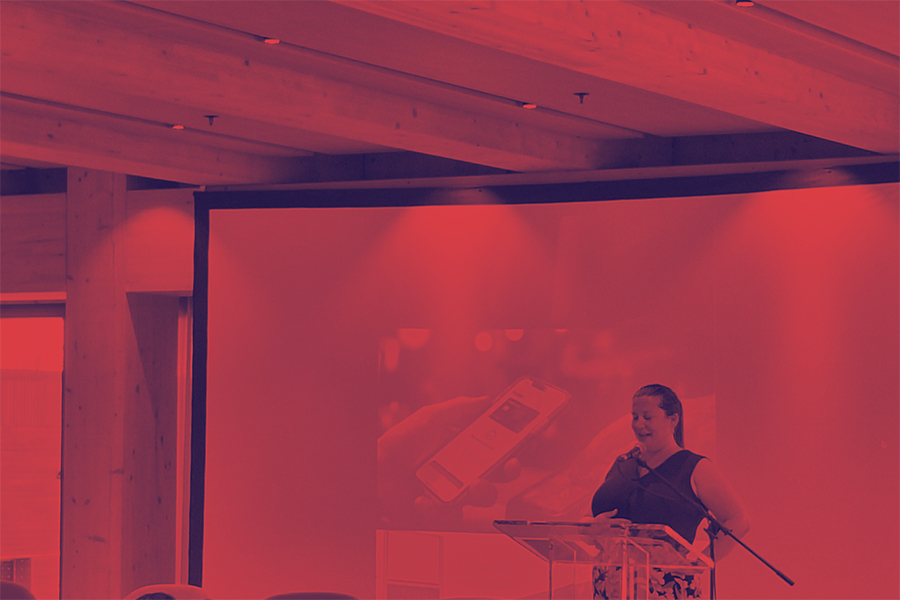
The following is the original text of the presentation given by Jocelyn Butler, Orchestra’s CEO, at Toronto Climate Week’s Carbon Solutions session. In it, she argues that we have a unique opportunity in this geopolitical polycrisis to change people’s behaviour by changing the way we talk to people - and organizations.
The actual presentation may have varied slightly due to both Jocelyn’s ad lib tendencies or audience signals.
Thank you all for being here.
I'm not here today to talk about carbon capture technology or policies for greenhouse gas emission reductions. You all know a lot more than I do about that and there is nothing I could say that would be new to any of you. But what I do know about, and what I am going to talk about today, is framing and communications.
We have a unique geopolitical polycrisis opportunity before us of which we must take advantage. But it means we have to change the way we talk about everything related to climate - be it carbon capture and decarbonization or emissions reductions programs.
For so long we've been doomwarning. We've been acting like chicken little 'the sky is falling, the sky is filling' with greenhouse gases, but how many were really listening?
The consensus in the global scientific community has been that the global temperature could only raise 1.5C max from pre-industrial levels and they've yelled from the rooftops we must make change - or else! Depending on how you measure, we're pretty much there. But we still have much of the global population saying 'not affecting me.'
We also have a nomenclature issue. Our popular language started with the phrase ‘global warming’ and we replaced it with ‘climate change’ as we discovered that temperatures are fluctuating more up AND down. That change created an open gateway for popular deniers and resistant influential leaders to grab the scared, the skeptics and the cynics under their wing.
So we find the world at a tipping point. Right now.
CAT weather events are hitting closer to home and our wallets. What felt like safe places to invest in building a family are suddenly not eligible for fire or flood insurance creating risk of not just physical safety, but financial. Gas prices are leading to budget changes at home and employees are asking for raises just to be able to get to work, putting economic stress not only on the individual but the small and mid-size business economy that feeds so much of North America.
Up until very, very recently, the moment any conversation started with 'carbon' (much less carbon solutions) the eyes glazed over and everyone looked like they were trying to find a way out of the room politely but quickly.
And the fossil fuel industry has been very careful at boiling the frogs slowly, balancing supply and price, capturing regulatory powers around the world in order to keep things going.
And then, Trump 2 happened - and is happening.
The resounding effects of affordability, security, AI, trade and war have changed the equation - the current hydrocarbon polycrisis is no longer affecting the amorphous 'we', it's affecting the 'me' and that presents an opportunity that is unusual in that it is not our usual B2B/B2G approach - it's B2C.
Because the court of public opinion, largely apathetic to this point, is paying attention. We in this room have an opportunity to not just build a competitive advantage for Canada, but leverage carbon solutions to move the middle and sway that court's perception in our favour.
So what do we do with this attention, then, that is so hard to get?
There are two targets against which we need to change the way we communicate in this space.
One, on the B2C front, we need to let people know (in the places where they consume trusted information) that these new hydrocarbon-reduction and removal considerations they are having are good! This is something common in advertising, we call it 'purchase affirmation.'
Two, on the B2B/B2G front, we also need to get a little bit loud about accomplishments and benefits in a way that ordinary folks feeling the financial crunch right now - can understand.
And we need to fund them both properly as deliberate campaigns, not rely on budget remnants to get the job done. As we at Orchestra have been saying all week, if you build it, they will not come...unless you've put some money behind letting them know you exist.
On the B2C angle — number one what we shouldn't do is berate people for being resistant/passive to this point. We as a general public are tired, over stimulated, over worked and worried. We cannot open our phones without a billionaire owned media outlet delivering us some other level of bad news. We need to hear the good.
When building campaigns to let the public know what you're doing...you literally need to be more fun. An organization's ESG report broken down into social posts will not convince a mother of 4 to change her driving habits. Or a Gen Z living in downtown Toronto who can barely afford their rent to change their purchasing habits because an organization has invested in carbon removal solutions.
Be loud, engage a creative agency that will get you out of the corporate speak. While the phrase 'Canadians don't love tall poppies' rings true for some, the introduction of the content creator in the 2010s is shifting that perspective. Combine that with the population's starvation for good news or signs that corporations really do care, this room's opportunity to snatch that audience and build loyalty is abundant. Our clients and our client's consumers are desperate to be proud of where they come from. Take advantage of that.
And we need to do it in the places where these particular people find their information - media fragmentation is real. The average consumer sees 10,000 brand logos a day. The number of ad units is ever increasing online, in-home, and outside. And how we are making targeting decisions is changing constantly and being dictated by a select few.
Truly successful and resonant campaigns no longer allocate a few hundred thousand to Meta and Google, then a few more with programmatic and call it a day. Some of you may be rolling your eyes at this generalization but this was literally said to me by a media buyer about a major organization yesterday. Her words 'it's the same template, every time.' It was the only way the agency could get the campaigns approved. The most successful campaigns live at the intersection of culture acknowledgement, advertising and community uplift. In a space that has the opportunity to ease minds and encourage behavioural shift, the people in this room have an incredible opportunity to find public adoption success.
On the B2B and B2G front, we need to get a little bit pushy, prideful and boastful about our accomplishments and benefits in a way that positions cleantech in the carbon solutions space as a growing and profitable piece of our economy.
We as Canadians tend to sit on our heels instead of beating our chest, unless the script has been paired down by legal, thus we fail at telling captivating stories about Canadian companies that are world leaders in carbon solutions and cleantech.
There are advances all over that actually make energy cleaner and more affordable for everyday people - and money is being made.
As has been said recently 'sunlight travels 150 million km to get here, and not one photon goes through the Strait of Hormuz.'
The geopolitical shocks are having unintended consequences:
Due to the combo of the USA restricting import of Chinese solar array and battery tech, and China's massive production volume and state subsidy offers of the same, homebased solar tech is massively affordable. Which has directly led to the rapid and massive electrification that has just occurred in Pakistan.
Speedy change is possible with the right investment. And it could be Canadian investment if we change the narrative and organizations reposition their offering to build business and government buy-in.
Take the recent development of small-footprint geothermal like our very own Canadian Eavor out of Calgary, where their zero-emission system can power 7 to 10 thousand homes from a zero-carbon footprint the size of this building. They had to go to Germany to get funding for a proof-of-concept.
Part of this is obviously due to the massive investments in Europe happening in this space. But part of it is how we are selling ourselves to each other. I recently spoke with the head of communications of a surgical mining organization. In truth, they are incredibly lucky to have her. Her zig zag through the marketing and PR industry gave her a breadth of experience to pull on, to create a unique pitch that landed them local seed funding. To give some context, she started in fashion and moved to B2C experiential before entering into this role. Her understanding of the Canadian consumer landscape gave her the competitive advantage to help craft a pitch that was unique and captured attention.
The second part of this conversation was the part that got me. Everyone she spoke to in cleantech mining and energy was shocked they secured financing in Canada. When she asked how others were building their pitch - they were relying on AI, or their consultants were relying on AI to create the brand and create the pitch. My fear is that this space is often trying to tell its story in the same way to save budget. While AI is an incredible tool and has mass adoption in the B2B and B2G space, on its own it will not help grow the investment in Canada's competitive carbon solutions opportunities.
When we speak to an organization, we are still speaking to people and if the campaign doesn't resonate with the same things a B2C campaign does, we'll miss the mark.
In the end, feel good stories change the narrative and affect how populations think about these things. They help create an atmosphere of hope, which is the foundation of the counter-cynicism we desperately need today.
So our key takeaway here is: external events have primed our B2C audience to be more receptive to our messaging than they have ever been and our B2B and B2G audience is yearning for opportunities that can create those stories.
Let's not waste their effect.
Thank you.